
When you are beginning to invest, it is natural to focus on returns.
Which fund should I own? Is the market going up? Can I find an investment that performs better?
But early in your financial life, investment returns are not the biggest driver of progress. The amount you save matters much more.
Consider someone with $10,000 in a 401(k).
If they contribute another $5,000, they increase the account balance by 50%. If the original $10,000 earns a strong 10% return, the investment gain is only $1,000.
At that stage, saving $5,000 has five times the impact of earning 10%.
That is why the foundation matters so much early in your career:
Getting financially organized
Building an emergency reserve
Eliminating expensive debt
Capturing your employer’s full retirement-plan match
Saving consistently
Increasing contributions as your income grows
Staying invested through good and bad markets
The investment strategy still matters, but it does not need to be complicated. When the balance is small, the most powerful thing you can do is continue adding money.
The relationship eventually changes
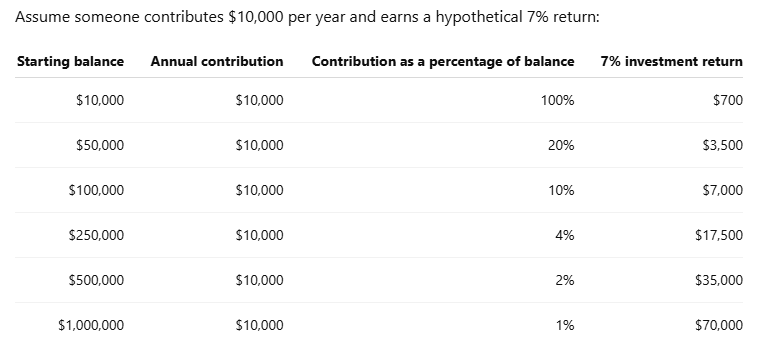
At $10,000, another $10,000 contribution can double the account.
At $100,000, that contribution adds 10%.
At $1 million, the same contribution adds only 1%, while a 7% return represents $70,000.
The contribution has not become unimportant. The portfolio has simply become powerful enough to create meaningful growth of its own.
Finding your crossover point
There is a simple way to estimate when expected annual investment growth becomes larger than annual contributions:
Annual contribution ÷ assumed return = approximate crossover balance
For someone saving $10,000 per year and assuming a 7% return:
$10,000 ÷ 7% = approximately $143,000
At that balance, a hypothetical 7% return and a $10,000 contribution each add roughly the same amount.
For someone saving $20,000 per year:
$20,000 ÷ 7% = approximately $286,000
This is not a guaranteed return or a specific financial target. Markets do not produce steady results each year. It is simply a useful way to understand when the portfolio may begin contributing more to its growth than the investor does.
This is where compounding begins to snowball
Compounding means that you earn returns not only on the money you originally invested, but also on previous investment gains.
Consider a $1 million portfolio earning a hypothetical 7% annually, with no additional contributions:
After one year: approximately $1.07 million
After five years: approximately $1.40 million
After 10 years: approximately $1.97 million
After 20 years: approximately $3.87 million
The first $1 million of growth takes roughly 10 years in this example. The next approximately $1.9 million arrives during the following 10 years.
Why does the second decade produce so much more?
Because the investor is no longer earning returns only on the original $1 million. Returns are also being earned on all the gains accumulated during the first decade.
The money is now building on itself.
That is the point when wealth can begin growing much faster than someone’s ability to add new dollars from a paycheck. The portfolio becomes another engine working alongside the investor’s career.
Of course, actual returns will be uneven. Some years will be positive, others negative, and taxes, withdrawals and investment costs will affect the outcome. But the underlying principle remains: the larger the asset base becomes, the more powerful compounding can be.
Different stages require different priorities
Early on, financial progress is driven primarily by decisions you can control:
How much you save
How consistently you invest
How quickly you increase contributions
Whether you avoid unnecessary debt
Whether you stay invested
As the portfolio grows, investment decisions carry greater consequences:
A 20% decline on $25,000 is $5,000.
A 20% decline on $1 million is $200,000.
A concentrated stock position can overwhelm years of savings.
Panic selling can interrupt decades of compounding.
Poor tax planning can create a large and avoidable bill.
The goal does not become finding investments with the highest possible return. It becomes protecting the conditions that allow compounding to continue: appropriate risk, diversification, tax efficiency, sufficient liquidity and the discipline to remain invested.
Know which stage you are in
If you are early in the accumulation process, do not become discouraged by a smaller balance. Your savings rate is still your greatest advantage. Focus on building the habit and increasing the amount invested as your income grows.
If your balance is approaching the crossover point, you have reached an important stage. Your contributions and investment returns are now working together, and the effects of compounding are becoming more visible.
If you have accumulated significant wealth, the challenge changes again. Investment returns can now move the portfolio by more than you earn or contribute in an entire year. Avoiding major mistakes and coordinating investment, tax, estate and risk-management decisions becomes increasingly important.
Early in life, you work to build your money.
Eventually, your money begins working alongside you.
And if you allow compounding enough time, it may ultimately do more of the work.
Once that happens, the financial playbook needs to evolve. I explain the planning decisions that become increasingly important after meaningful wealth has been accumulated in my prior newsletter post below:
