
“I don’t want the promotion. It’ll push me into a higher tax bracket.”
I’ve heard this from a client more times than I can count.
Sometimes it’s a promotion.
Sometimes it’s a bonus.
Sometimes it’s someone considering a Roth conversion or exercising stock options.
The concern is almost always the same:
“If I make more money, won’t I end up paying so much more in taxes that it isn’t worth it?”
It’s one of the most common misconceptions about our tax system.
Fortunately, it’s also one of the easiest to fix.
Here’s what most people don’t realize:
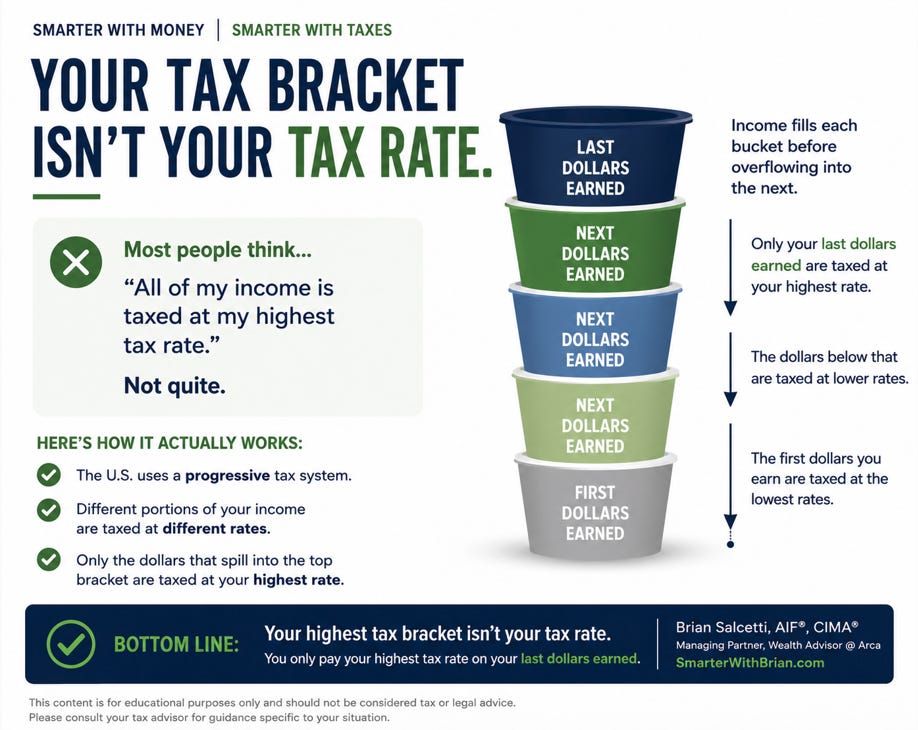
Let’s walk through an example.
Imagine Sarah earns $225,000 a year.
Her employer offers her a promotion that increases her salary to $250,000.
She’s excited...until someone tells her: “Be careful. You’re moving into a higher tax bracket. That raise isn’t worth it.”
It sounds believable. It’s also wrong.
Sarah doesn’t suddenly pay the higher tax rate on all $250,000 of income.
She only pays the higher rate on the portion of her income that falls into that bracket.
Think of tax brackets like filling buckets.
You fill the lowest bucket first.
Once it’s full, the next dollars spill into the next bucket.
Only the dollars in that bucket are taxed at that bucket’s rate.
That’s why the United States is called a progressive tax system.
Marginal Tax Rate vs. Effective Tax Rate
This is where many people get confused.
Your MARGINAL tax rate is the tax rate on your next dollar of income.
It’s usually the number people quote.
Your EFFECTIVE tax rate is the average rate you pay across all of your taxable income.
For someone earning around $250,000, it’s entirely possible to have:
Marginal Tax Rate: 32%
Effective Tax Rate: Around 18–20% (before considering state taxes, deductions, credits, and other factors)
Those are two very different numbers.
And understanding the difference changes how you make financial decisions.
Why this matters
This misunderstanding doesn’t just affect promotions.
It influences decisions about:
Accepting bonuses
Working overtime
Exercising stock options
Roth conversions
Retirement withdrawals
Selling appreciated investments
Year-end tax planning
I’ve seen people walk away from opportunities because they misunderstood how tax brackets work.
That’s an expensive mistake.
The bigger lesson
Taxes matter.
But good financial planning isn’t about avoiding taxes at all costs.
Sometimes paying more tax today means earning significantly more income, building greater long-term wealth, or reducing taxes later in retirement.
The goal isn’t to pay the least amount of tax this year.
The goal is to make the best long-term financial decision.
The Bottom Line
Your highest tax bracket is not your tax rate.
Only your last dollars earned are taxed at your highest marginal rate.
Understanding that one concept can change how you think about raises, bonuses, retirement planning, and investing.
Sometimes the most expensive financial decisions aren’t caused by the markets.
They’re caused by misunderstanding the rules.