
A high income helps.
But income alone doesn’t create wealth.
Wealth is built in the gap between what you earn and what you spend—and what you consistently do with that difference.
Plenty of high earners struggle to accumulate wealth because their spending rises with every raise. Meanwhile, people with more modest incomes can build meaningful financial security by following a few good habits for a long time.
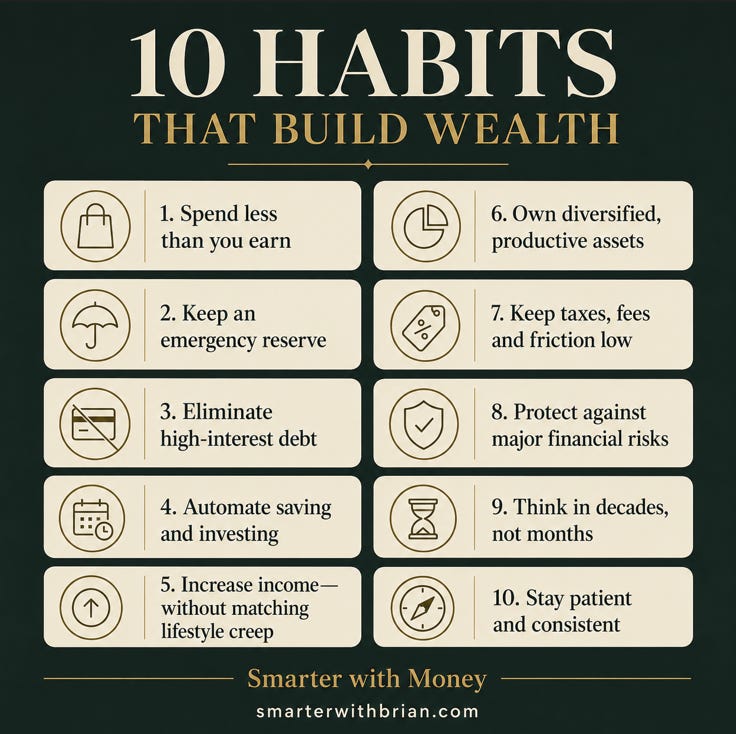
Create room to build wealth
The first step is simple, but not always easy:
1. Spend less than you earn.
You don’t need to avoid everything you enjoy. The goal is to spend intentionally enough that part of every paycheck is available for your future.
2. Keep an emergency reserve.
For most households, that means keeping roughly three to six months of essential expenses in cash. The right amount depends on the stability of your income, upcoming expenses and how many people rely on you.
Cash may not earn the highest return, but it can prevent an unexpected expense from turning into credit card debt or forcing you to sell investments at the wrong time.
3. Eliminate high-interest debt.
Paying off a credit card charging ~20% interest effectively requires you to earn ~20% return before taxes. Very few investments offer anything close to that without substantial risk.
Make progress automatic
Good financial habits work best when they don’t depend on willpower.
4. Automate saving and investing.
Schedule contributions shortly after each paycheck arrives. If the money never sits in your checking account, you are less likely to spend it.
Even relatively small amounts can become meaningful over time. Investing $500 per month for 30 years at a hypothetical 7% annual return would grow to approximately $610,000—even though only $180,000 was contributed.
5. Increase income without matching lifestyle creep.
Earning more can accelerate nearly every financial goal, but only if you keep some of the increase.
One practical rule is to save or invest half of every raise, bonus or unexpected windfall. Your lifestyle can still improve, while your financial progress accelerates too.
Own assets and keep more of the return
Saving money is important. Owning assets is what allows that money to compound.
6. Own diversified, productive assets.
That could include businesses, stocks, bonds, real estate or other investments capable of growing in value or producing income.
The objective isn’t to find the next winning investment. It’s to consistently own a diversified collection of productive assets.
7. Keep taxes, fees and friction low.
Returns matter, but so does how much you keep.
Thoughtful account selection, tax-efficient investing, avoiding unnecessary trading and coordinating investment decisions with your tax plan can all improve long-term results.
None of these decisions may seem life-changing in isolation. Their value compounds over decades.
Protect the plan
Building wealth is only part of the job. You also need to protect what you are building.
8. Protect against major financial risks.
That means having appropriate insurance, maintaining updated estate documents, reviewing beneficiaries and avoiding financial risks that could permanently derail the plan.
Insurance should protect against losses you cannot comfortably absorb—not every minor inconvenience.
Give compounding enough time
The final two habits may be the most important.
9. Think in decades, not months.
Markets will fall. Strategies will go through disappointing periods. Someone will always appear to be getting rich faster.
A good financial plan should not require you to predict what happens next month. It should be built to survive many different environments over many years.
10. Stay patient and consistent.
Wealth is rarely created by one brilliant decision. More often, it comes from a series of reasonable decisions repeated for a long time.
Spend thoughtfully. Save automatically. Own productive assets. Manage taxes. Protect against major risks. Then give the plan time to work.
The habits are simple.
The hard part—and the part that makes the biggest difference—is continuing to follow them.