
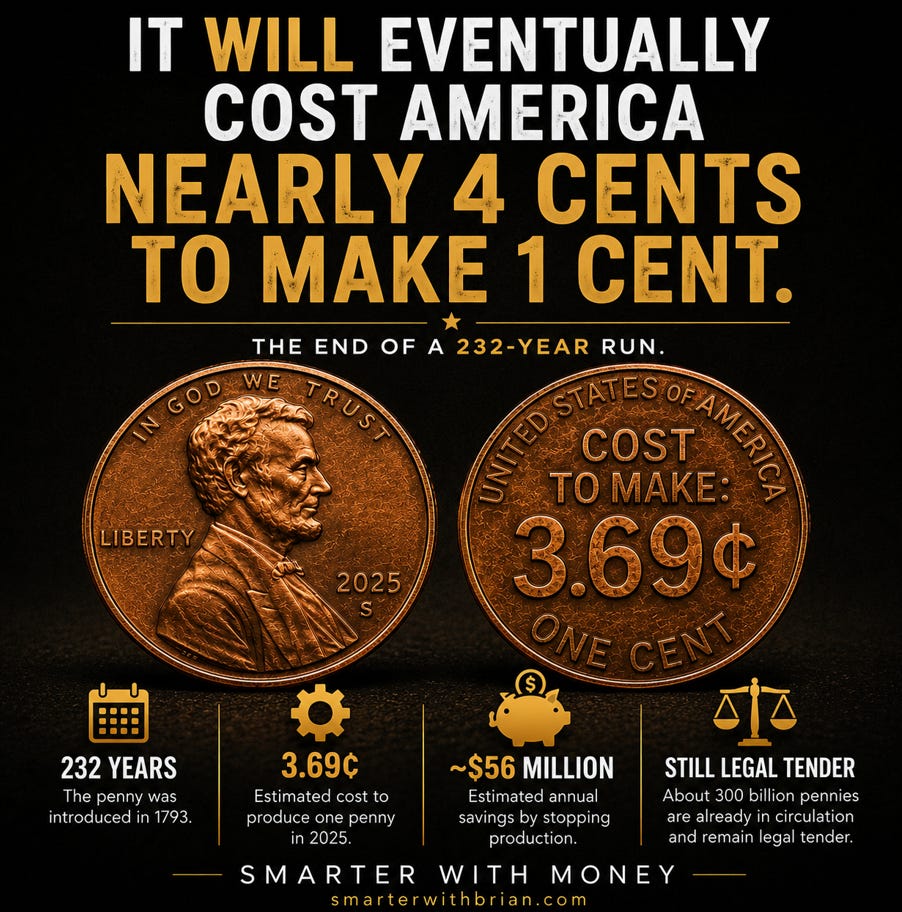
It will soon cost America nearly 4 cents to make 1 penny.
I was at the grocery store yesterday and noticed a sign at checkout:
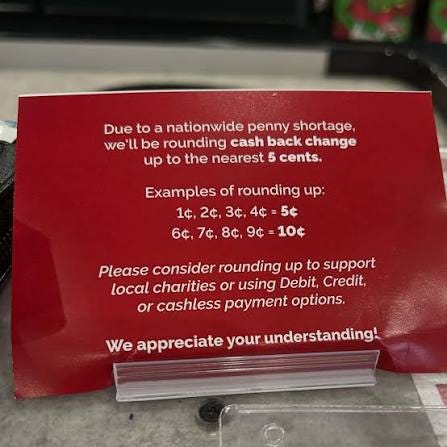
Customers paying with cash may have their totals rounded when exact change isn’t available. Why?
The U.S. stopped producing new pennies for circulation in 2025.
After a 232-year run, the penny had simply become too expensive to make.
The U.S. Mint estimates that the cost to produce a single penny had climbed to 3.69 cents—nearly four times its face value.
And we were making a lot of them.
In fiscal year 2024 alone, the Mint produced approximately 3.2 billion pennies, representing 57% of all circulating coins it produced that year.
By suspending production, the Mint estimates annual savings of roughly $56 million.
So, are pennies going away?
Not exactly.
There are an estimated 300 billion pennies already in circulation, and they’re still legal tender.
The government simply decided it no longer made much sense to keep manufacturing billions of new one-cent coins at several times what they’re worth.
And now we’re beginning to see the effects in everyday life—even at the grocery store.
A small change.
But an interesting example of how economics eventually catches up with even the most familiar parts of our money.
Sometimes even money becomes too expensive to make.
Source: U.S. Mint